
Bradford Factor Calculator

Bradford Factor Calculator
Measure the impact of employee absence on your organization
Formula: B = S² × D
Where S = number of spells (occasions) of absence, D = total days absent
Benchmarks:
✓ 0–49: Low — No concern
● 50–124: Moderate — Monitoring recommended
⚡ 125–399: Concern — Action may be needed
⚠ 400–649: High — Formal action likely required
🚨 650+: Serious — Immediate intervention needed
The Bradford Factor Calculator is a workforce management tool used to measure the impact of employee absenteeism on business productivity. It helps employers identify patterns of frequent short-term absences, which often cause more disruption than long-term leave.
Managing employee absence is important for every business. Too many short-term absences can affect productivity and employees’ performance. This is where a Bradford Factor becomes useful. The Bradford Factor is a simple formula used in HR to measure how often employees take sick leave. It focuses more on frequent short-term absence rather than long-term sickness.
In this guide, you will learn:
- What the Bradford Factor is
- The Bradford formula
- How to calculate Bradford score
- What is a good or bad Bradford factor score
- How it affects absence management

What Is the Bradford Factor?
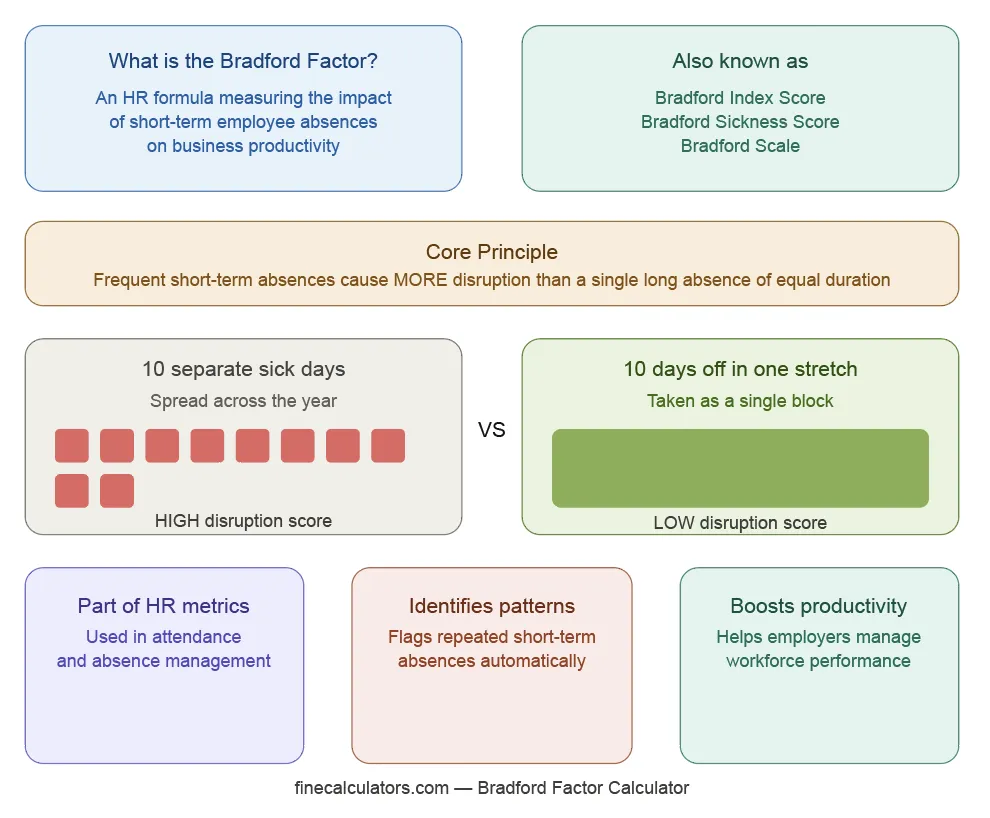
The Bradford Factor (also called the Bradford Index Score or Bradford sickness score) is a method used by companies to measure employee absence. It is part of attendance management and HR metrics. The idea behind the Bradford scale is simple:
Frequent short-term absence has a bigger impact on business than one long absence.
For example:
- 10 single sick days spread across the year create more disruption than 10 days taken at once.
This is why the Bradford scale calculator gives higher scores for repeated absences.
Bradford Factor Calculator Formula
The Bradford formula is:
Bradford Factor = (Number of Absence Occasions × Number of Absence Occasions) × Total Days Absent
OR
B = S² x D
B = Bradford Factor
S = Number of Absence Occasions
D = Total number of days absent
In simple words:
- Count how many times the employee was absent (absence occasions)
- Multiply that number by itself
- Then multiply by total days absent
This is the official Bradford score calculation used by HR teams.How to Calculate Bradford Factor Step-by-Step
Here’s how to calculate Bradford score manually:
Step 1: Count Absence Occasions
Count how many separate times the employee was absent.
Step 2: Count Total Days Absent
Add up the total number of sick days.
Step 3: Apply the Bradford Formula
Multiply absence occasions by itself, then multiply by total days absent.
Example:
An employee was absent 3 times in a year for a total of 7 days.
Bradford Score = (3 × 3) × 7
Bradford Score = 9 × 7
Bradford Score = 63
So, the Bradford index score is 63.
Many HR teams now use a Bradford score calculator or Bradford scale calculator to get instant results instead of calculating manually. Just like a financial calculator online helps with quick percentage or ROI calculations, this tool simplifies absence tracking.
Check out our Break-even Calculator
What Is a ‘Good’ or ‘Bad’ Bradford Factor Score?
There is no single “perfect” score because companies set their own absence policies. However, here is a general guide:
| Bradford Factor Score | Description |
|---|---|
| 0-49 | Low Score (Usually no concern) |
| 50-124 | Monitor Attendance |
| 125-399 | Formal Review may be required |
| 400+ | Possible Disciplinary Action |
A high Bradford sickness score usually means frequent short-term absence.
However, HR must always consider:
- Medical conditions
- Disability-related leave
- Long-term sickness
- Legal protections
The Bradford scale should not be used blindly. Context matters.
Bradford Factor – Comparison Between Two Employees
To understand how the Bradford Factor Calculator works, let’s compare two employees with the same total number of sick days but different absence patterns.
Employee A – One Long Absence
- Absence Occasions: 1
- Total Days Absent: 10 days
Bradford Formula:
(Absence Occasions × Absence Occasions) × Total Days Absent
Calculation:
(1 × 1) × 10 = 10
Bradford Score = 10
Employee B – Multiple Short-Term Absences
- Absence Occasions: 5
- Total Days Absent: 10 days
Calculation:
(5 × 5) × 10 = 25 × 10 = 250
Bradford Score = 250
Comparison Result
Both employees were absent for 10 total days, but their Bradford index scores are very different:
- Employee A Score: 10 (Low impact)
- Employee B Score: 250 (High impact)
This example clearly shows how two employees with the same total days off can have very different Bradford sickness scores.
Learn more about Attrition Rate Calculator
Why Do Companies Use a Bradford Factor Calculator?
Businesses use a Bradford scale calculator for several important reasons:
- To monitor employee attendance patterns
It helps HR track how often employees are absent over a specific period. - To reduce frequent short-term absence
It highlights repeated short absences that may disrupt daily operations. - To improve workforce management
It allows managers to plan staffing better and reduce unexpected disruptions. - To support HR compliance
It provides documented data that supports fair and consistent attendance policies. - To protect overall workplace productivity
It helps reduce absence-related delays that can impact team output and business goals.
Frequent absences can disrupt teamwork, delay projects, and affect employees’ performance, which is why the Bradford index score helps HR identify patterns early and take timely action.
Bradford Factor vs Other Absence Metrics
The Bradford score is not the only attendance metric.
Other common tools include:
- Absence percentage
- Attendance rate
- Total sick days
- Productivity metrics
You can use our Absence Percentage Calculator which shows overall time off, the Bradford scale focuses on frequency of absence. Both are important for full HR analytics.
Final Thoughts
The Bradford Factor Calculator is a helpful tool for HR teams managing employee attendance. It highlights patterns of short-term absence and supports better workforce planning.
However, the Bradford formula should always be used fairly and carefully. When combined with good HR practices and employee support, it can improve attendance without harming workplace morale.
If used correctly, the Bradford scale becomes a powerful part of modern absence management.
Discover Average Fixed Cost Calculator
FAQs
What is the Bradford Factor?
The Bradford Factor is a formula used to measure employee absence frequency, especially short-term absence.
How is the Bradford Factor calculated?
It is calculated using the Bradford formula: (Absence Occasions × Absence Occasions) × Total Days Absent.
What is the Bradford scale?
The Bradford scale is the scoring system used to measure absence frequency and its impact on the workplace.
What Bradford score triggers disciplinary action?
Many companies review scores above 125 and may take disciplinary action above 400, depending on policy.
Does the Bradford Factor apply to long-term sickness?
The Bradford scale mainly focuses on frequent short-term absence, not long-term sickness.
What is a Bradford score calculator?
A Bradford score calculator is an online tool that automatically calculates the Bradford index score based on absence data.
