
Average Collection Period Calculator

Average Collection Period Calculator
Measure how quickly your business collects payments
Average Collection Period: (Accounts Receivable ÷ Net Credit Sales) × Days in Period
AR Turnover Ratio: Net Credit Sales ÷ Accounts Receivable
Daily Credit Sales: Net Credit Sales ÷ Days in Period
An Average Collection Period Calculator allows businesses to quickly determine how long it takes to convert credit sales into cash.
Managing cash flow is essential for every business. One of the most important financial metrics that helps measure how quickly a company collects payments from customers after making the sale is the Average Collection Period.
Whether you are a small business owner, accountant, or financial analyst, understanding this metric helps improve liquidity, working capital management, and overall financial planning.
In this article, we explain what the average collection period in finance is, how to calculate it, and provide a clear example for better understanding.

What Is the Average Collection Period?
The Average Collection Period (ACP) measures the average number of days a business takes to collect payments from customers after a credit sale.
It is also known as:
- Debtors Collection Period
- Average Debtors Collection Period
- Days Sales Outstanding (DSO)
The average collection period ratio indicates how efficient a company is at managing its accounts receivable. A shorter period means customers are paying quickly, while a longer period may signal collection problems.
What Is the Average Collection Period Formula?
The ACP can be calculated by two methods:
- Average accounts receivable
- Receivables turnover ratio
We will explain both along with their formulas.
Average Accounts Receivable
Average Accounts Receivable is the mean amount of money a company is owed by customers over a specific period. It represents the typical balance of receivables and is calculated by adding the beginning and ending accounts receivable for a period and dividing by two.
The formula for average collection period is:
Average Collection Period= (Accounts Receivable ÷ Net Credit Sales) × Days in Period
where;
- Accounts Receivable – Money owed by customers
- Net Credit Sales – Total sales made on credit (not cash sales)
This figure helps businesses measure how efficiently they collect payments from customers and is commonly used in calculating the Average Collection Period and Receivables Turnover Ratio.
Check out our Additional Funds Needed Calculator
Receivables Turnover Ratio
Receivables Turnover Ratio is a financial metric that measures how efficiently a company collects payments from its credit customers during a specific period.
It shows how many times, on average, accounts receivable is converted into cash. A higher ratio indicates faster collection and effective credit management, while a lower ratio may suggest slow collections or lenient credit policies.
The formula is:
Receivables Turnover Ratio = Net Credit Sales ÷ Average Accounts Receivable
Daily Credit Sales: Net Credit Sales ÷ Days in Period
Step-by-Step Guide for How to Calculate Average Collection Period?
You must be worried and looking for:
- How do you calculate the average collection period?
- How to find the average collection period?
- How to calculate average collection period accurately?
Here is the simple process:
Method 1: Using Average Accounts Receivable
This method directly calculates the number of days it takes to collect payments from customers.
Step 1: First, calculate the average amount customers owe during the period.
Average Accounts Receivable= (Beginning A/R + Ending A/R) ÷ 2
This gives you the typical receivables balance for the year.
Step 2: Next, determine the total credit sales made during the period.
Use net credit sales only (exclude cash sales).
Step 3: Now, apply the Average Collection Period formula to find the number of collection days.
Average Collection Period= (Accounts Receivable ÷ Net Credit Sales) × Days in Period
This result shows how many days, on average, customers take to pay.
Method 2: Using Receivables Turnover Ratio
This method first calculates how many times receivables are collected in a year, then converts it into days.
Step 1: Start by calculating the average receivables balance.
Average Accounts Receivable= (Beginning A/R + Ending A/R) ÷ 2
This provides the average outstanding balance.
Step 2: Then, calculate how many times receivables are collected during the year.
Receivables Turnover Ratio= Net Credit Sales ÷ Average Accounts Receivable
This tells you how frequently receivables turn into cash.
Step 3: Finally, convert the turnover ratio into days.
Average Collection Period= 365 ÷ Receivables Turnover Ratio
This gives the average number of days required to collect payments.
Learn more about Attrition Rate Calculator
Business Example for Better Understanding
Let’s assume for a business:
- Beginning Accounts Receivable = $20,000
- Ending Accounts Receivable = $30,000
- Net Credit Sales = $200,000
Step 1: First, calculate the average accounts receivable.
20,000+30,0002=25,000
Average Accounts Receivable = $25,000
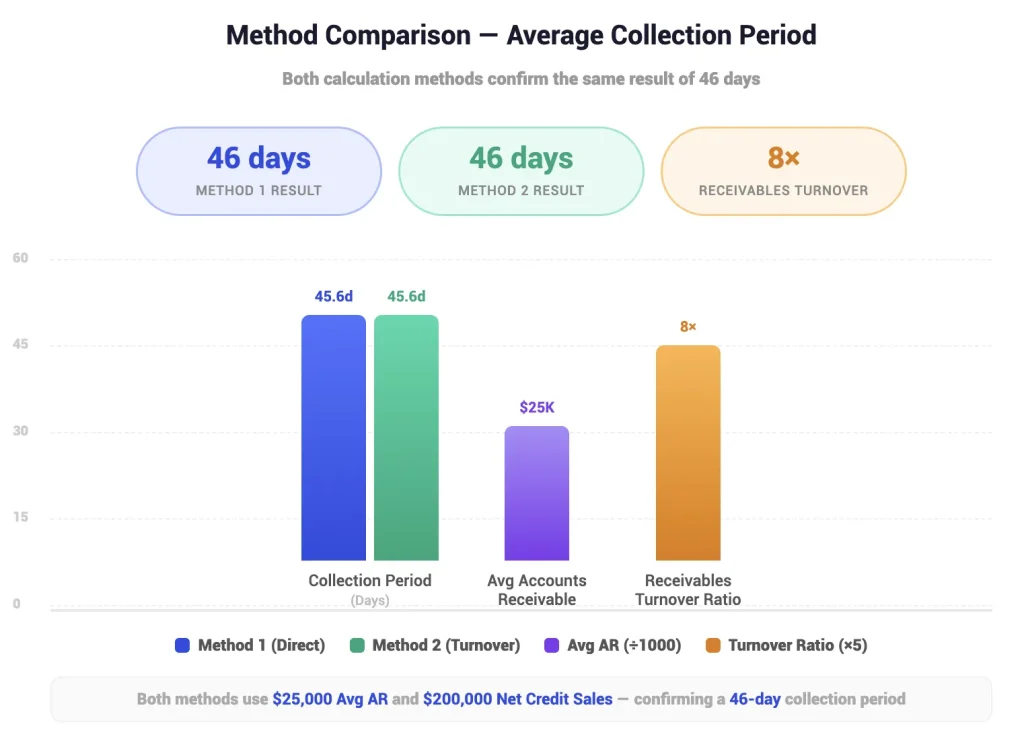
Calculation through Method 1- Average Accounts Receivable
Apply the ACP formula directly:
25,000÷200,000 ×365=45.6
Average Collection Period = 46 days (approximately)
Calculation through Method 2- Receivables Turnover Ratio
Now, calculate the receivables turnover ratio with the help of formula:
200,000÷25,000=8
Then, convert it into days:
365÷8=45.6
Average Collection Period = 46 days (approximately)
Thus, the company takes about 46 days on average to collect payments from customers.
How Average Collection Period Ratio Helps Businesses?
The average collection period ratio helps businesses:
- Measure receivables efficiency
- Evaluate credit policies
- Monitor cash inflows
- Assess liquidity
A lower ratio means faster collections and stronger cash flow. A higher ratio may require tightening credit terms.
Why Is the Debtors Collection Period Important?
Knowing the average debtor’s collection period formula is important because it directly affects:
- Working Capital
- Cash Flow Management
- Financial Planning
- External Financing Needs
If customers pay slowly, businesses may need short-term loans or additional funding.
How Is Average Collection Period Calculator Different from Other Calculators?
The ACP calculator focuses on receivables efficiency. It differs from other calculators like GRP Calculator as it measures advertising reach and frequency for marketing campaigns, not financial efficiency.
While profitability tools show how much money you make, the average collection period shows how quickly you collect it.
What Is a Good Average Collection Period?
There is no single “perfect” number. It depends on:
- Industry standards
- Credit terms (30, 45, 60 days)
- Business model (B2B vs B2C)
Generally:
- 30-45 days → Healthy for many industries
- 60+ days → May indicate collection inefficiencies
Discover Average Fixed Cost Calculator
Common Mistakes When Calculating Average Collection Period
When calculating average collection period, avoid:
- Using total sales instead of net credit sales
- Confusing total annual income with credit revenue
- Ignoring seasonal fluctuations
- Not comparing results to industry benchmarks
Conclusion
The Average Collection Period Calculator is a powerful financial tool that helps businesses measure receivables efficiency and improve liquidity management. By using the average collection period formula, companies can determine how quickly they collect payments and make better financial decisions.
Understanding how to calculate average collection period is essential for maintaining healthy cash flow and long-term financial stability.
FAQs
What is the average collection period in finance?
It measures the average number of days a company takes to collect payments from customers after a credit sale.
How to get the average collection period quickly?
Use an Average Collection Period Calculator to avoid manual errors.
How do you calculate the average debtors collection period?
It is calculated using the same formula as ACP and represents debtor days.
Why is calculating the average collection period important?
It helps businesses manage cash flow, improve credit policy, and reduce reliance on external finacing.
